Real Estate Is the Canary in the Coal Mine: How AI Transparency Laws and Synthetic Media Are Coming for the Visual Industry
I realized real estate is a microcosm of what's to come. The canary so to say. As I dug more into this I saw what's happening in this industry to potentially happen everywhere.


If you want to support my independent reporting, subscribe to Cinema Ex Machina for free. You can also become a supporting member or you can leave a tip. 🍻 Cheers!
In my interview with Chris, we discussed the quickly changing real estate landscape. What I've realized: real estate is a microcosm of what's to come. The canary so to say. As I dug more into this I saw what's happening in this industry to potentially happen everywhere.
The statement by the Anthropic CEO about 50% of entry level jobs going bye-bye in 1-5 years, holds true in this industry as well. Of course, there are high-end real-estate and architectural photographers but, an entry-level, a fresh-faced young adult with a brand new FAA drone operators permits - these folks are directly in the cross hairs.
I wanted to dive in to the tools, what realtors are saying, what legislatures are saying and try to get a grasp on this canary to hopefully help us predict the future. Or, at least, not be surprised by it.
The Tools
First, let's look at some available tools to realtors. The interesting thing I've found about the concept of these tools is they seemingly are every photographer or cinematographers worst nightmare. Snap 10 cell phone pictures and you have yourself an entire campaign.
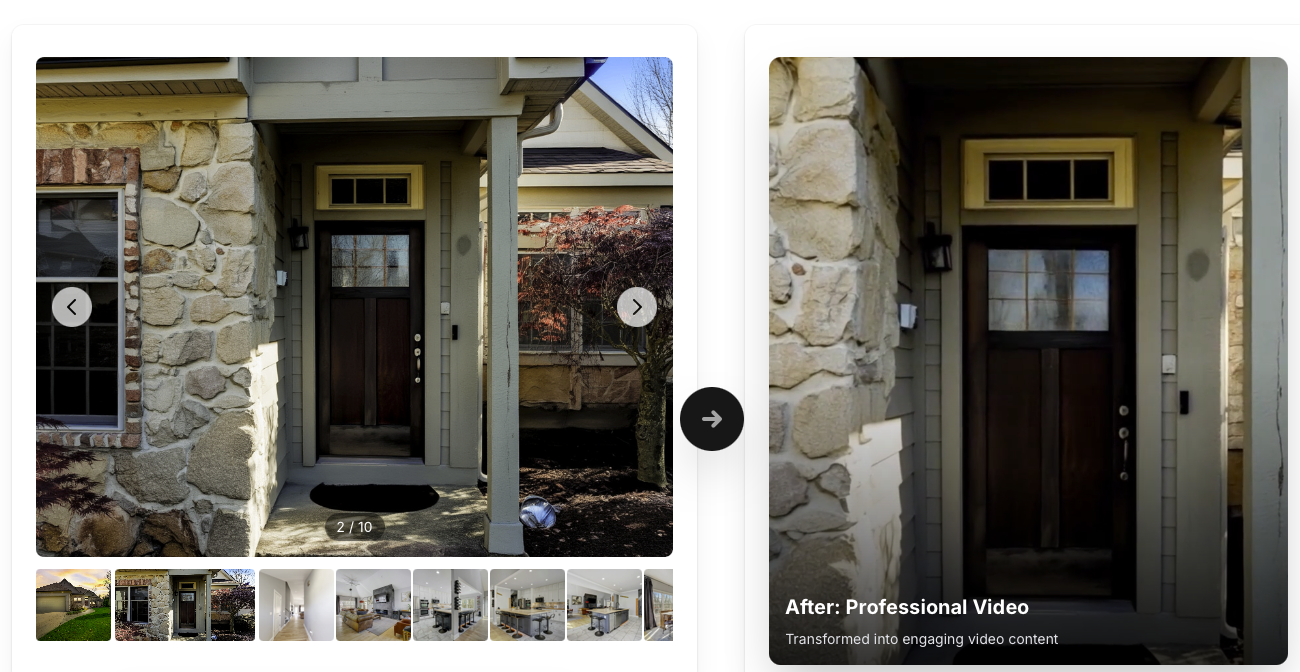
Stunning property videos for a fraction of the cost
The deal here is you upload 3-10 photographs of your property and their service will create a walkthrough video of your home. I'm going to reserve my opinions on what the videos actually look like but you can judge for yourself from their Instagram page.
They also offer virtual staging and photo enhancements.
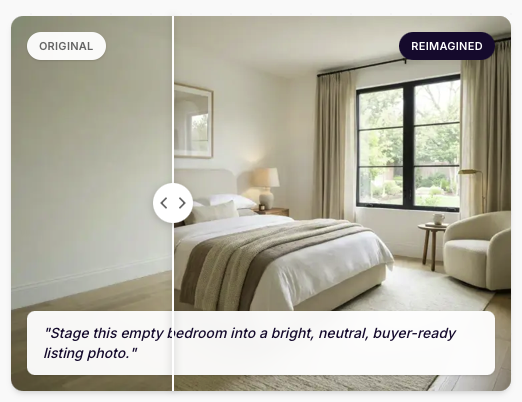
Turn raw photos into a listing-ready gallery in one pass. Upload the full listing set. We sort by room, flag compliance, apply fixes and enhancements, then export a market-ready gallery.
A couple interesting features here:
- For virtual staging you can design with "real products chosen for your space, taste and budget". Is the virtual bed a budget piece or is it premium, or a "designer pick". Giving you control over what kind of products to place within the environment.
- They are very conscious of misrepresentation, with this on the front-page of their website: "You have to present the listing in its best light - without misrepresentation - and get it sold."
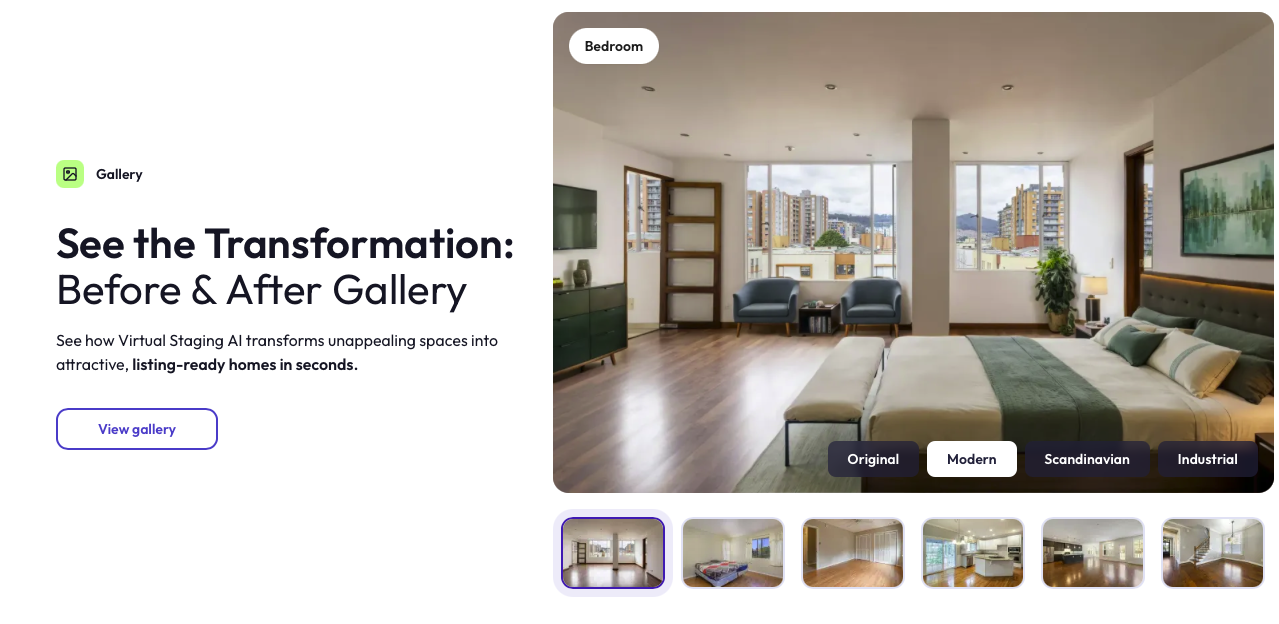
Virtual Staging with one click. Upload a picture and our AI will add furniture within seconds.
Another tool with a concentration on staging. They're also offering Image enhancement with the idea that a realtor can self-snap phone photographs and the AI can pop out a usable image.
So the tools, as they sit now are already rather advanced. I talked to a realtor who called herself "old school" and said AI property listings make her "cringe" but also said virtual staging is different as it is such an incredible time-saver and valuable tool for realtors. Food for thought!
Ethics & Standards
It's very interesting that one of the tools above blatantly mentions misrepresentation - you don't hear that much in the AI hype that's currently happening. To admit that your tool is capable of misrepresenting your product is bonkers. Seemingly, when you're looking for that price cut of not hiring professional staging or photography the risk might be worth it.
That risk, specifically, has been addressed by the National Association of Realtors:
Relying on AI-sourced knowledge places the agent or brokerage in danger. - National Association of Realtors
In danger! You don't get clearer language than that. With those kinds of words, it seems realtors as a whole are being cautious. To prove that caution, NAR has also added AI language to their official ethics documentation.
Article 2 holds that “REALTORS® shall avoid exaggeration, misrepresentation, or concealment of pertinent facts relating to the property or the transaction.” Article 12 says, “REALTORS® shall be honest and truthful in their real estate communications and shall present a true picture in their advertising, marketing, and other representations.”
As an example, Hecht noted, “using AI to remove a structural crack from a wall violates those two Articles, but removing a hose and bucket accidentally caught in a picture is different.” - National Association of Realtors
NAR is trying to draw lines into what's right and wrong because they see a potential outcome of legal liability and tarnished reputations if realtors are misrepresenting listings. That just makes everyone look bad, and in many cases it's illegal.
Last, WAV Group, a real estate industry publication, has certain thoughts on AI as it stands today, from their article, Real estate is suffering from AI misinformation:
Real estate conferences need to get rid of the self-serving AI sales pitches, academics who talk over our heads, and false “experts” who have little AI and/or real estate industry knowledge. As someone who has written more than 240 stories about real estate and AI in the last two and a half years, I wish we had an “AI BS Meter” at every conference. I volunteer to push the button.
Legal Repercussions
As consumers, we're generally protected by truth-in advertising laws and consumer protection laws. Also, realtors could face disciplinary action from real estate commissions if they're selling with too much slop.
Recently California's Assembly Bill 723 has passed and became law on October 10, 2025. This law, entitled "Real estate: digitally altered images: disclosure", seeks to reinforce existing consumer protection laws by specifically addressing the need to disclose digitally altered pictures.
Stunning but misleading visuals can expose agents and sellers to liability under California’s consumer protection and advertising laws, as well as disciplinary action from the Department of Real Estate (DRE). In other words, the short-term savings from bypassing a photographer could lead to long-term legal and reputational costs. - Bornstein Law
This legislation is first of its kind and I'm seeing in my research that 2026 is going to be the year where we start seeing state regulation into AI images.
California’s AB 723 marks a turning point for real estate compliance, pressing the industry to address the gap between rapidly advancing AI image generation and lagging detection capabilities. With other states poised to adopt similar rules, MLS operators must implement detection tools promptly or risk legal and reputational consequences. - KeyCrew
A law firm in Florida asks, Is Florida Next?
California is making AI-edited listing photos a disclosure and documentation issue with criminal consequences for willful violations under its licensing law. Florida has not passed the same statute, but Florida already prohibits false, deceptive, or misleading advertising, and that is the exact place AI photo misuse lands. If you want the safest play for 2026, act like AB 723 is coming to Florida anyway: disclose material edits, label virtual staging, keep originals, control your vendors, and do not edit reality. - Barnes Walker
Photographers Holding Strong
From researching on Reddit, there's the usual doom & gloom about AI taking jobs, but the folks in r/realestatephotography don't seem all that worried. I honestly didn't think that would be the case but photographers (at least on reddit) have confidence in their craft. Here's some select comments from the thread: I think AI will kill REP within 5 years.
The biggest issue with AI right now is how to make a profit. It's incredibly expensive to operate the costs are only going up. All of these popup companies are in a honeymoon phase where they have access to servers for free to help "grow the AI" but at some point that freebie time period will run out and companies will have to start paying for the computing and charging clients a lot more money. As a real estate agent, do you want to pay a lot of money for cringe AI photos with warped text and random artifacts or do you just pay a professional that adds value to your brand?
I dont think it kills REP. I think it serves as tool much like photoshop/lightroom, but x10000.
As a vfx artist, i don't think you could be more wrong. Maybe cheap agents that will eventually be amongst the 80% that quit in the first 2 years will opt for something like this. But not somebody seasoned in understanding people want good photos and video that are 100% true to what they are getting
As an agent (broker) our time is better spent getting new listings and showing buyers places. Sure some will be stupid but most agents know the value of a good photographer to get their listing up and running. If they waste time on DIY pics who's going to do the paperwork? It just is not a good look to sellers and If I was a prospective seller I'd fire that broker that shot their own pics on the spot.
Nah it’s simple as hell to do a floor plan with CubiCasa et al already but my clients still all pay me well to do it. Maybe the cheapo clients will still take their own photos and try to edit with AI but the ones who are the better agents and know to put focus where it matters (ie not doing the marketing media creation themselves) still aren’t going to want to do it. They have better things to do with their time. Those are the clients you want anyways.
Realtors Are Using AI but Not as Extensively as You Think
And this is why I will be sitting a realtor down and doing an interview ASAP. Stay tuned, but for now, you can see a pattern from commentary on the r/realtors subreddit. From my research, many realtors are using AI for admin work, some for handling leads and emails and there’s plenty using image generation. Nobody seems all in, everybody seems to be playing it cool. Again, I have a couple of realtors in mind that I’d like to interview to hear some definitive thoughts.
most of the AI video tours look totally janky right now. buyers spot the weird artifacts immediately.
where I actually get value is virtual staging. instead of paying a service $40 a photo, I use a web app where I just drop in my raw iPhone pics of an empty room, type in a style like 'mid-century modern living room', and it spits out photorealistic staged concepts in seconds. I just use them to show buyers the potential of a dead space.
My least favorite thing is AI enhanced photos used in listings to cover up poor staging.
Some of the things I’ve seen do scream gimmick, but as a marketing tool, when applied to larger marketing campaigns and plans, it’s definitely not a gimmick. In my opinion, client/consumer facing content will always be better received when it’s generated authentically. But AI can really help you dial in and scale your larger marketing activities.
Some of the AI video tours and flashy visuals feel a bit over the top right now. Where it’s been useful is the stuff like drafting listing content, organizing marketing materials, and keeping follow up moving in the background. When that’s tied into your site and marketing system, it keeps everything moving without adding more work for the agent.
Did you find value in this article? I worked hard to bring this issue to the fore with multiple sources and a 2000+ word post. I plan to research and follow this as it develops, please consider becoming a supporter so I can continue this important work.
In Conclusion
Bornstein Law sums this topic up nicely:
While AI is rapidly transforming real estate like every other industry and empowering professionals with new tools, expect further actions to regulate its use.
For Realtors and housing providers alike, compliance is more than a legal box to check. Accurate photos help with expectations, reduce disputes, and protect against claims that can be far more expensive than honest, transparent marketing. - Bornstein Law
This canary in the coal mine isn't as disastrous as you thought entering this article, hey? Consumers are going to want and probably demand the media they're looking at is honest. From our other articles, without disclosure, consumers can get very uncomfortable. Of course, realtors are going to chase efficiencies in their work, but as Bornstein Law says - at what cost? Pay for a legitimate photographer now, or potentially suffer expensive consequences down the road.
What this research has told me is that AI is not inevitable. Sure, it's going to help in many places and photographers and filmmakers jobs are going to become more competitive but that's par for the course with new technology.
For a laugh, I included some photographs from a realtor's listing that I found via reddit. Would you buy a house from this person?


Until next time. Thanks for subscribing and/or supporting CXM.