What Audiences Really Think About AI in Branding and Entertainment
There's many surveys tracking our audience's feelings towards AI in both entertainment and marketing. A lot of these numbers will surprise you, a lot of them will make your cold heart, warm.


If you want to support my research & reporting, subscribe for free. You can also become a supporting member or you can leave a tip. 🍻 Cheers!
In July 2024, Netflix CEO Ted Sarandos said that audiences “don’t care” if AI is used in the film and television programming they watch. For us as filmmakers and content creators, we understand why the c-suite is saying this. Ted goes on: "I'm pretty sure there's a better business and a bigger business in making content 10% better than there is in making it 50% cheaper."
But, for him, and for us, and everyone doing this crazy gig - it's all about audience. Marketers can't market to a response of revulsion, theaters can't survive if audiences aren't behind what's being shown and on the other side, we're out of jobs if the audience truly doesn't care as Ted claims.
I'm not totally sure Ted is right, but I also don't think he's totally wrong either. As usual, a modicum of nuance is required.
Let's Start Here, with a Quick 1, 2 Punch.
In February this article came across my network: "AMC Theaters Will Refuse to Screen AI Short Film After Online Uproar". This film Thanksgiving Day won an AI centered festival and the prize included a two-week run in theaters nationwide. When this information leaked online, the backlash was swift, loud, and AMC decided not to run the content.
 James Hibberd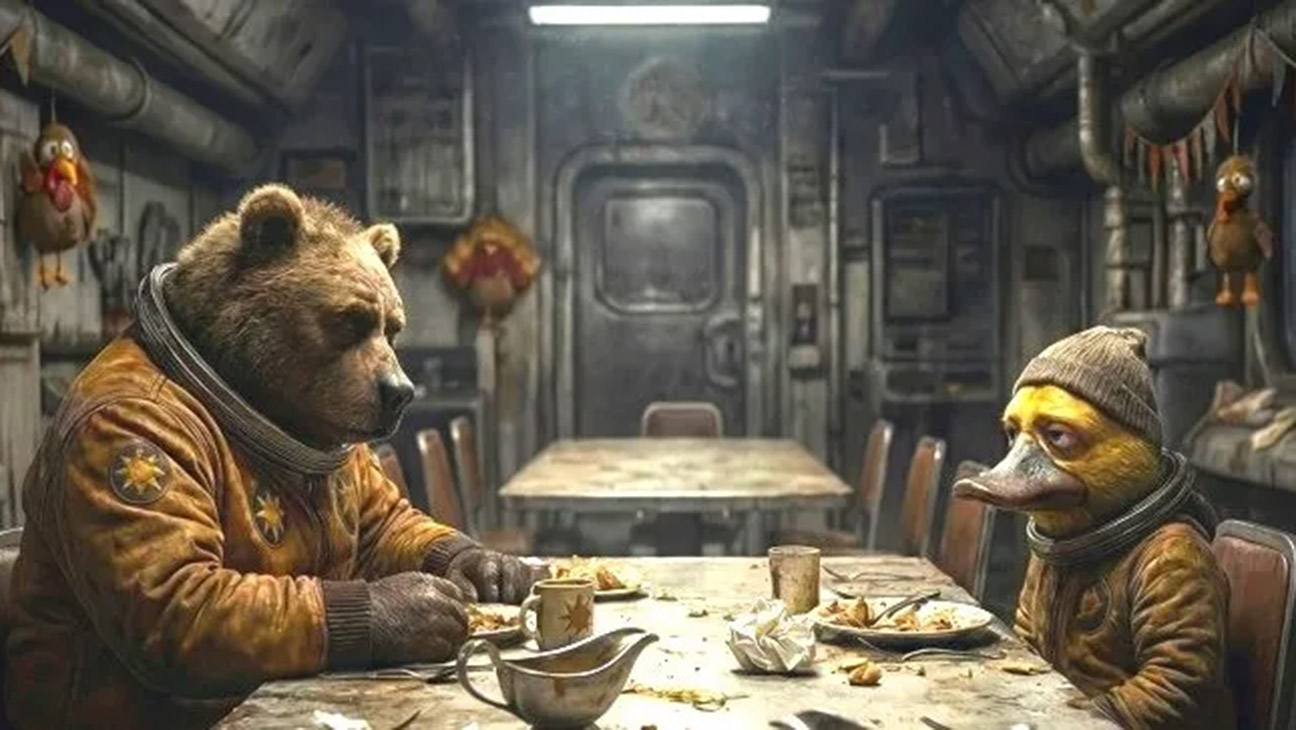
This very quick FAFO moment is the very reason I'm writing this post. This wasn't even a film you're paying for, it's something that plays before the lights fully go down and audiences, seemingly, are not having it.
To go back to our buddy Ted at the top, he says "if AI is used" - this is a clear distinction from what happened with the AMC/Thanksgiving Day saga. Audiences revolted against a wholly AI made, artificial film whereas Ted is being much subtler than this. As us creatives know, using AI to transcribe, pre-vis, mask track is becoming standard fare that our audiences wouldn't know about or, likely, wouldn't bat an eye at.
So, to contrast with what I said above, Ted isn't totally wrong either (so far). There's some really interesting surveys conducted into exactly this but I want to take a slight detour into branding first.

Help get CXM off the ground - take 50% off an annual subscription. I'm working hard to bring you actionable intelligence at the intersection of AI and visual storytelling. Expires June 1, 2026.
Artificial Branding
Forbes recently released an article titled 55% Of Audiences Are Uncomfortable With AI—Are Brands Listening? And it's very illuminating.
Nielsen’s recent study found a notable level of trust in AI tools, with 87% of users expressing moderate to high trust in AI.
So audiences, for their own personal use, used as their own tools, have a high margin of trust with AI. I assume this because audiences are using these tools themselves and feel they have a sense of control over them.
However, the story shifts when AI is applied to media. Compared to familiarity with AI overall, awareness of its role in creating content and advertisements drops to 69% Moreover, once audiences detect AI-generated content, discomfort grows: 55% of respondents feel uncomfortable on websites that rely heavily on AI-generated articles and stories. The distrust deepens further, with nearly half (48%) reporting they do not trust brands advertising on such sites.
This is fascinating. People trust the AI tools they use but aren't as aware that AI is being used to create the content, and therefore, the ads that they're consuming. And when they do, audiences aren't happy. Enough to do brand damage to the advertisers associated with the content.
If brands are listening, the path forward is clear. Transparency must become the foundation of AI strategies. Clearly communicating how AI is used—whether in ad targeting or content creation—can help rebuild trust.
Ad Audiences Want Disclosure
Disclosure is a word I heard somewhere else, in an IAB (Interactive Advertising Bureau) article with the subheading Consumer Skepticism Persists as AI Advertising Expands—But Disclosure Can Close the Gap
First, IAB brings this statistic
83% of ad executives now say their company has deployed AI in the creative process, up from 60% in the 2024 study.
And further, the scariest metric for all of us:
Generative AI is now a cornerstone for video ad creation, with 86% of buyers are using/planning to use it to build video ad creative, according to IAB’s 2025 Digital Video Ad Spend & Strategy Report.
I'll probably spend some time with this at a later date, but we're talking about audiences and the rest of this report is very interesting.
Advertisers are clearly loving the cost cutting AI provides but:
Advertiser perceptions of AI don’t align with consumer attitudes. 82% of ad executives believe Gen Z/Millennial consumers feel very or somewhat positive about AI-generated ads, nearly double the 45% of consumers who actually feel that way. This gap has widened from 32 points in 2024 to 37 points in 2026.
And that gap has only widened. I keep thinking that audiences will just submit to the slop but 5 percent more folks were convinced to say no thank you over a time-period of 2 years! It's interesting to see marketers out-of-touch with their audiences (no further comment ;)).
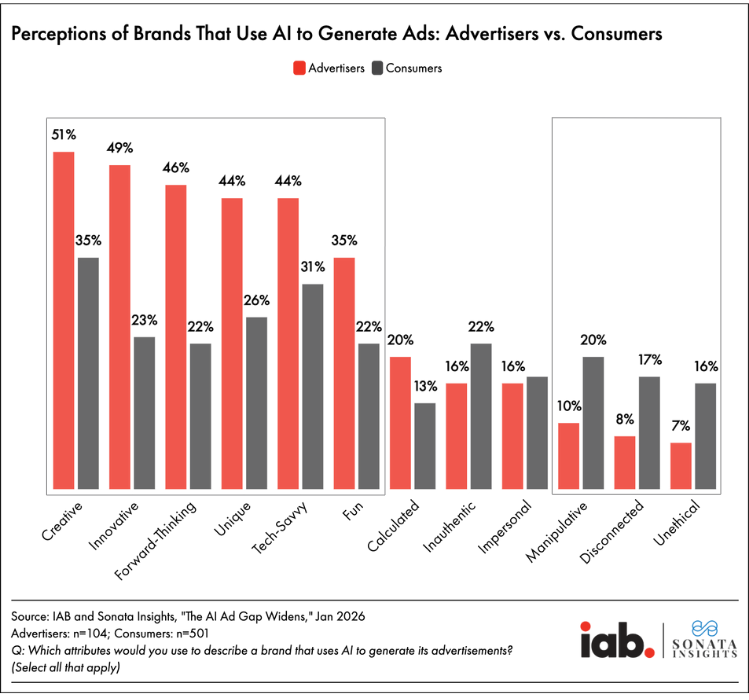
For AI in branding and advertising, let's wrap this up with a word we found above: Disclosure. These are some interesting statistics.
Disclosing AI usage can draw consumer attention to AI ads. In our survey, clear disclosure is the third-highest driver of attention, behind high-quality visuals/graphics and having funny content.
and
Disclosing also influences purchase consideration. Among Gen Z and Millennial consumers, 73% said if they knew an ad was created with AI it would either increase or have no difference on their likelihood to purchase the product or service. These findings suggest disclosure has more upside than downside when advertising to Gen Z and Millennial audiences.
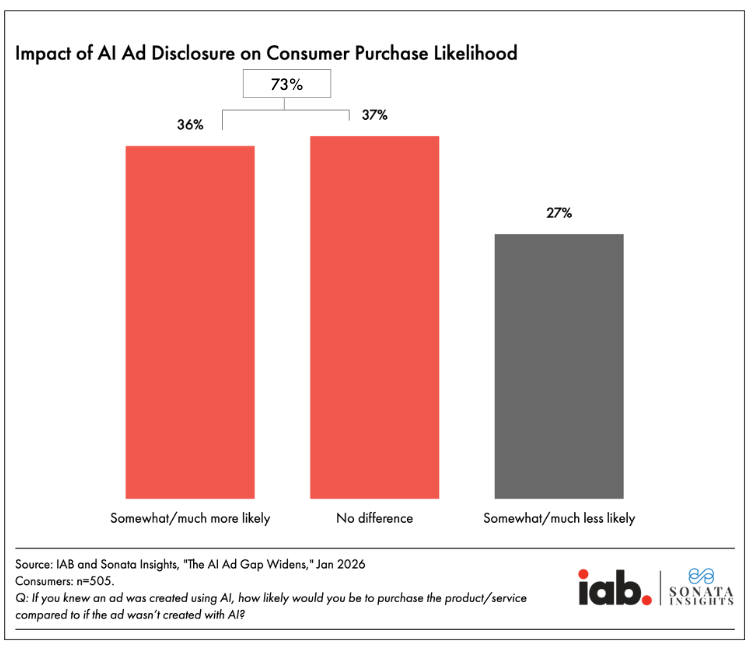
Let me say that again! If you disclose that your ad is generated by AI audiences either are likelier or are indifferent to purchasing your product. This lines up with the Forbes article. Moving forward I have a feeling we'll see a lot more "made by AI" and creative plays in the advertising industry. We're already seeing the opposite as well, "made by humans".
AI in Filmmaking
Back to filmmaking. A Baringa poll found a statistic that lines up with the AMC debacle above.
52% of U.S. consumers over the age of 16 would rather watch a 7/10 rated movie created by humans than a 9/10 rated movie created entirely by AI.
and
only 11% of U.S. survey respondents said they would be happy with AI-only films and television shows. - Baringa
11%! I can't even imagine what that 11% of people are like. As of now, I think it's safe to say audiences want real stories, made by real humans. We value the humanity and imperfection shared that a robot can't replicate.
Justine Bateman, filmmaker, actress, helped negotiate AI guardrails in the 2023 writers guild strike and vocal AI-critic, agrees. From a recent Time article:
Bateman believes that soon enough, both creators and audiences will get sick of AI slop and demand a new way forward. “I think the audience wants something real. And if you’re a filmmaker who decides to use generative AI, you’re stopping your forward progress,” she says. “You’re giving up.” - Time, 2026
I personally believe we have a consensus here, and to be totally honest this is the consensus I want to believe: Humans want human stories.
Sue me, I'm biased.
It's All Very Nuanced, It's the "How"
This is where things start to get interesting because we haven't addressed ol' Ted's "if AI is used" quote from the beginning of this article. We've been talking about and surveying for the consensus on fully artificially generated content, not the more nuanced conversation of AI being used as a tool in the production of films and stories.
Luckily for us, YouGov did some polling on exactly this issue. They're trying to discover the line that AI and audiences walk.
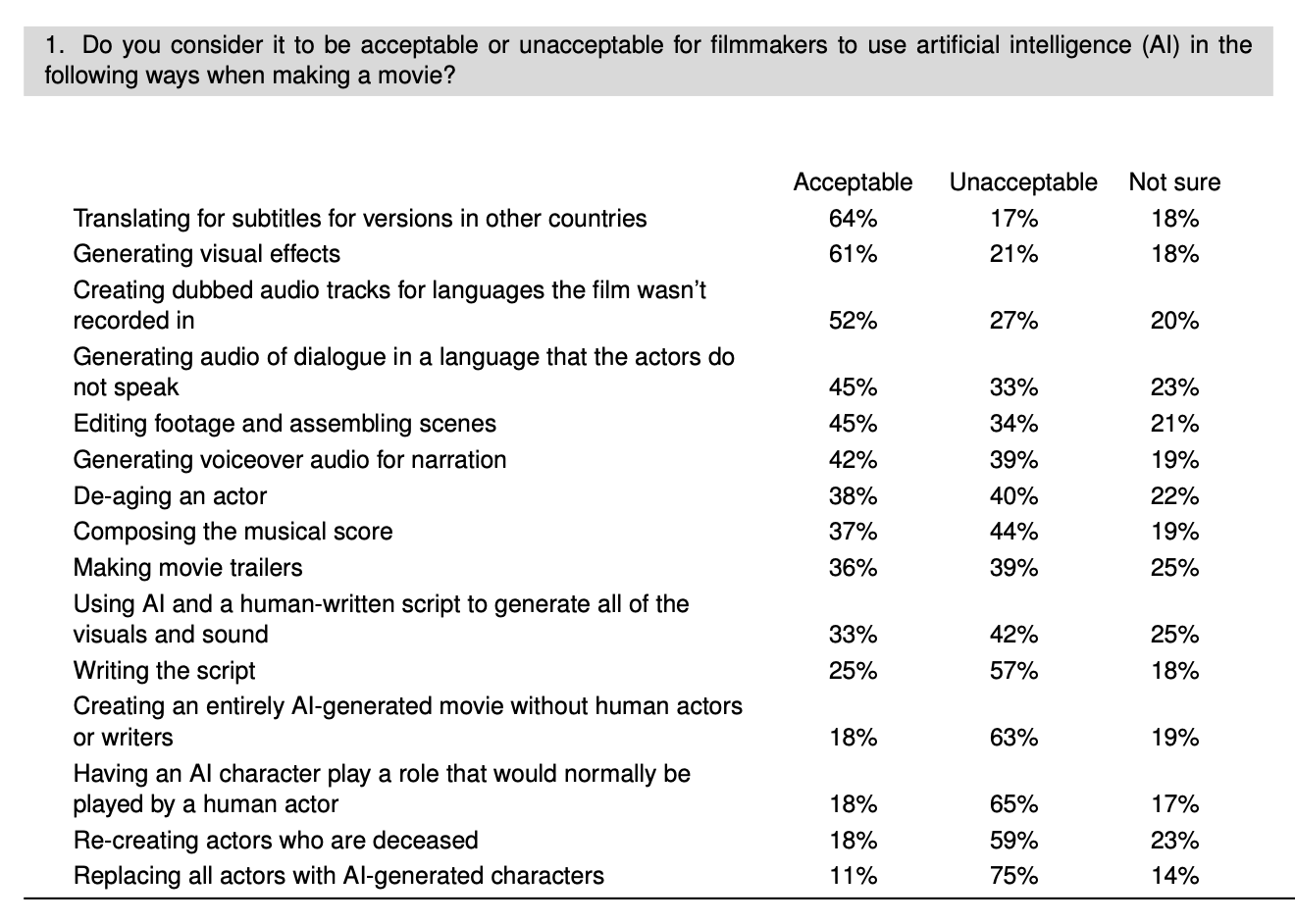
a majority of Americans would rather watch actual movie stars rather than deep fakes. 61% of the 1,665 U.S. adults surveyed say it's a "bad idea" to include digital replicas of actors generated by AI in movies and TV shows. - Yahoo
Meanwhile, 63% of those polled also think it's a "bad idea" for Hollywood to open the door for more movie and television scripts generated by AI instead of human writers
Viewers are most comfortable with AI being used in supportive roles such as translating speech into subtitles or helping surface relevant content. By contrast, audiences are least comfortable with AI being used to generate actors or create core elements of films and television programmes. This suggests that while AI is broadly accepted in operational roles, its use in lieu of human actors and scriptwriters raises different concerns. - YouGov
I think what's striking for me are the acceptable percentages. Only 38% in this study think it's acceptable to de-age an actor, a technique already used many times and that number drops quickly when we're recreating actors who are deceased. Even only 52% find it acceptable to generate audio of dialogue in a different language, something that in my opinion is a brilliant use of AI. I guess we just like real vocal cords and that warms my cold heart.
Technology Has Always Powered Storytelling.
The YouGov study shows that using AI as a tool to make better stories, not to actually MAKE the stories, is exactly what I'm seeing in our community. If we can use AI to clean up an audio track, we're going to as long as it still hits our very human standards. If we can rotoscope a shot that we've never been able to rotoscope before because of time/money - we're going to do it and our audience won't be the wiser.
Movie magic, baby. We've been using it for a 100 years now to suspend disbelief.
It’s everywhere and it’s nowhere, it’s invisible and it’s all over the screen. - New York Times Magazine, 2024
As Tom Hanks says in the same article:
This was not A.I. creating content out of whole cloth, this is just a tool for cinema — that’s all. No different than having better film stock or a more realistic rear-screen projection for somebody driving a car.
So, Our Dude Ted Sort of Ends up Being Right, in a Roundabout Way.
It's not that audience's don't care, it's how AI is used for them to be on-board.
To end on a lighter note, and a small left jab at Ted, aka The Man:
Gen Z is reviving DVDs and Blu-rays, with video rental shops reporting record months and membership numbers as young people embrace physical media.
 Follow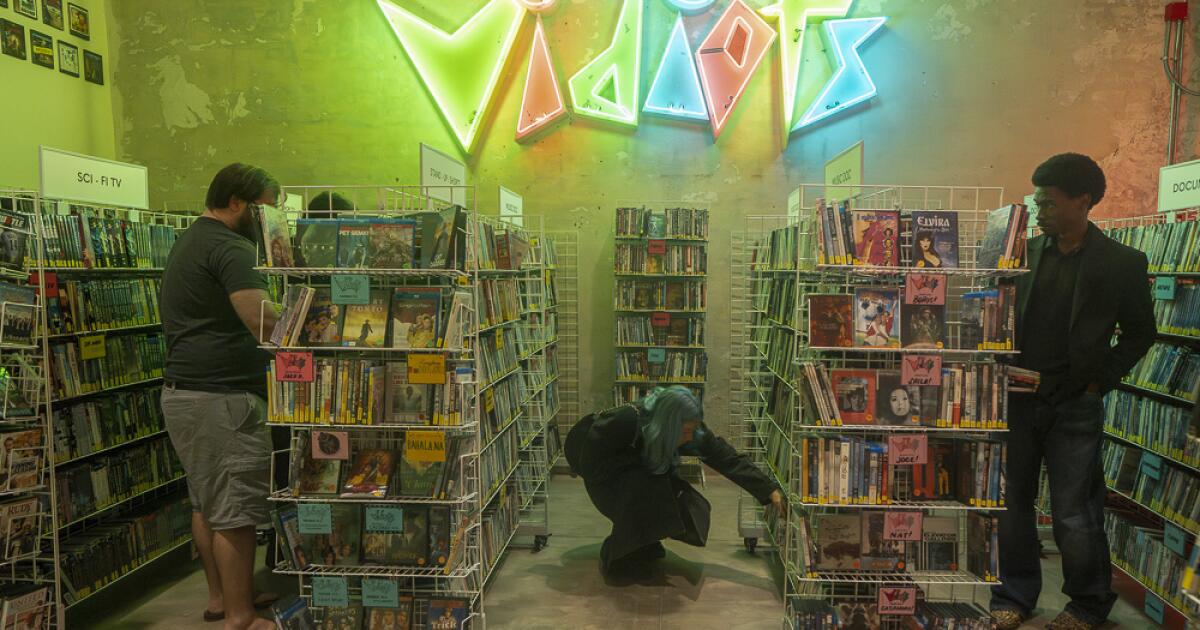
Sounds like Ted has his own problems.
Please subscribe or support if you found this article valuable.
Until next time.
-rc