Video Production Beware: the RAM and Storage Shortages are Coming Directly for You
As digital creatives we not only create and store a ton of data, we have to process it. AI's demand for both these critical components is really going to bungle things up for all of us.

If you want to support my independent reporting, subscribe for free. You can also become a supporting member or you can leave a tip. 🍻 Cheers!
With the oft-talked-about mega investments into data centers everyone seems to be making nowadays, here's a boring but critical topic that will directly affect us:
RAM & Storage.
RAM helps render our precious frames via our high end computers but it's also in your phone, in your TV, in your camera, your router. It, and hard drives, are ubiquitous in the world of technology and AI's demand for it is really going to bungle things up for all of us.
A changing storage landscape
HDD's are already sold out in 2026
I saw many outlets reporting that Western Digital, which was estimated in 2024 to hold 51.5% of the market, is sold out of hard drives for 2026. Let me repeat that,
the hard drive company that holds a 50% market share has no more hard drives to sell in 2026 because AI data centers have bought them all.
Please manage your data accordingly! I have a feeling I'll be revisiting this. I write off the price of HDD's on my clients but nowadays a few hundred bucks can be the difference between a green light or not.
 Stephen Warwick
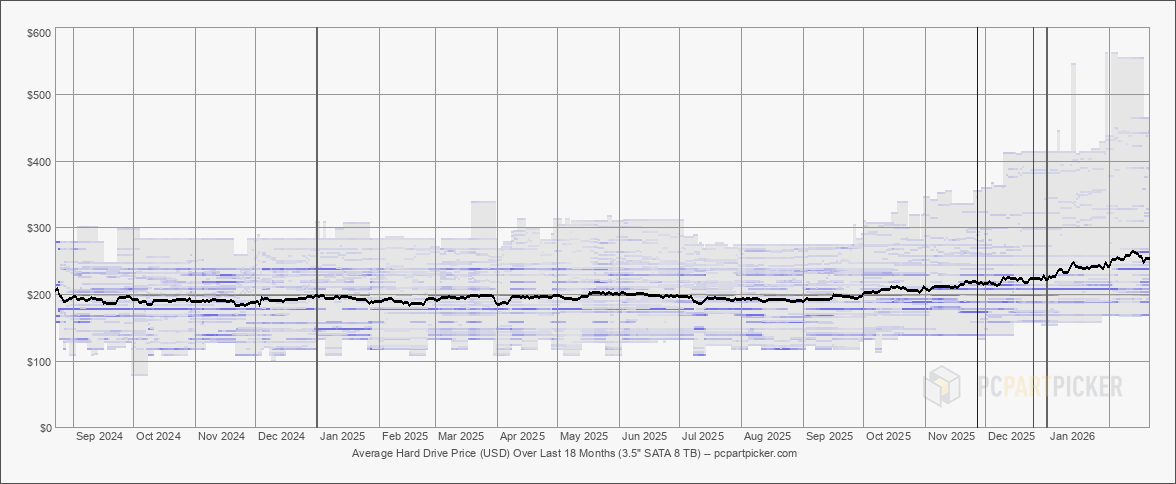
With that kind of a shortage, it's definitely going to affect the market - let's take a look at what PC Part Picker is saying.
HDD prices
The first thing I noticed when looking at 3.5" HDDs: the price is up but not at a crazy trajectory like SSD's (coming next). There's a lot more volatility here but things are mainly holding pretty steady.
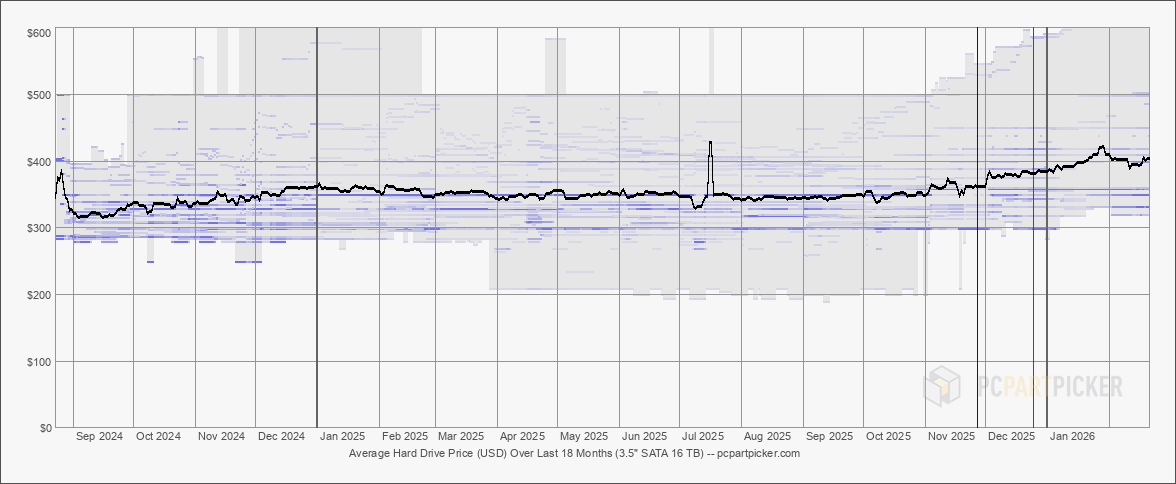
This what we need to pay attention to: SSD's are changing the landscape of how our data is stored at scale.
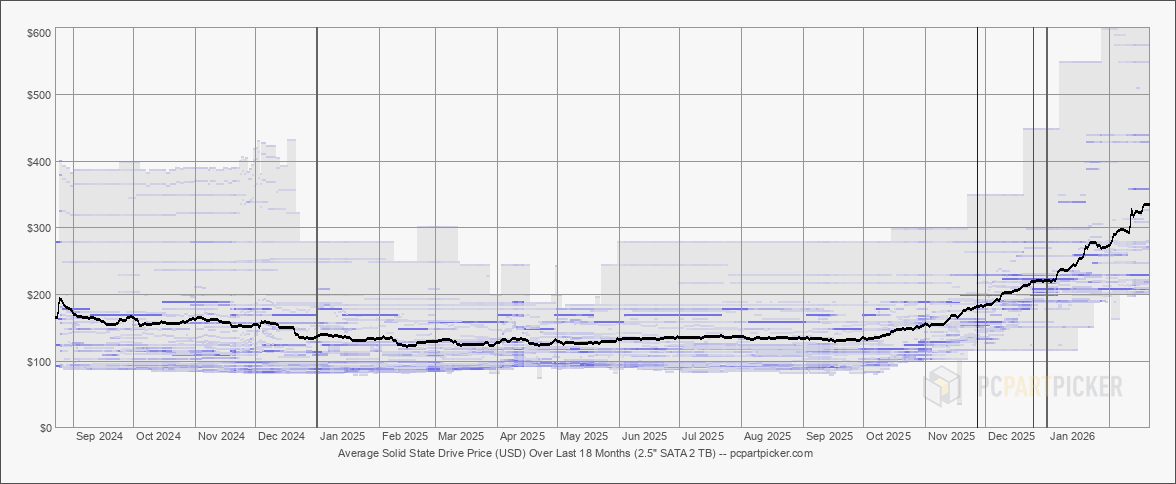
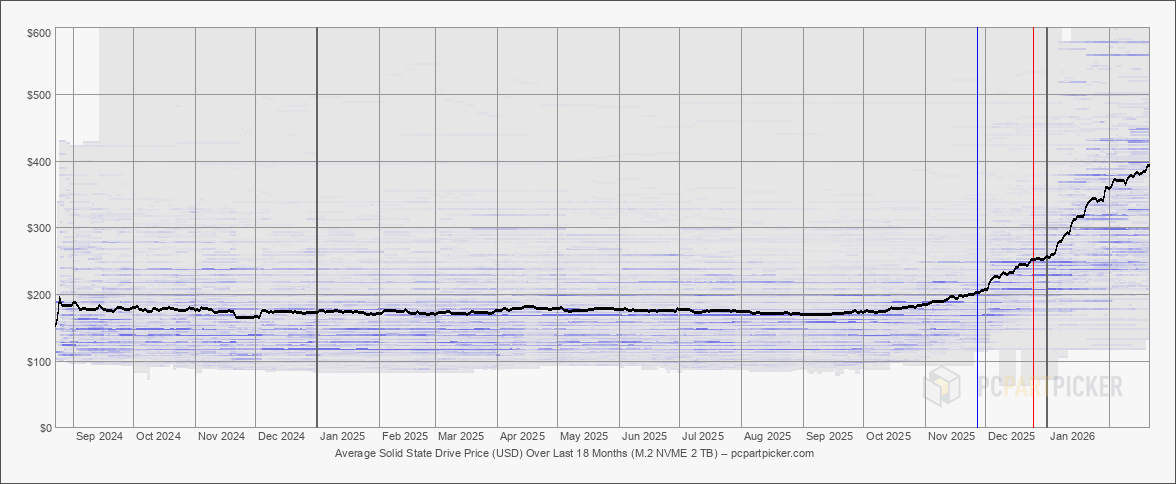
As you can see, SSD drives are on the rise as more build-outs of data centers happen, I have a feeling we'll see this price continue to rise. After looking into it, it sounds like the cost-benefit of spinning disks and SSD's has finally flipped.
The rise of AI workloads has exposed the limitations of HDDs and accelerated the shift to SSDs. What was once a cost-driven tradeoff is now a multidimensional advantage in performance, density, endurance, efficiency, and integration with AI accelerators. - Embedded
Basically, SSD's have now come into their own, at scale. They're faster, you can jam more into your building, they're more efficient and last longer.
From Fast Company with an article titled: Is 2026 finally the year for data center storage to cross over to SSD's?
When every watt must justify itself against GPU throughput, utilization, and scale, performance-per-watt and capacity-per-rack calculus favors SSDs—independent analyses show high-capacity QLC SSDs delivering materially better TB/W and higher effective rack utilization than nearline HDDs, enabling denser AI infrastructure within the same power and floorspace envelope.
So, HDD's may be safe from critical price increases but SSD's are probably, even now with the current rises in price, a very developing story.
I use 3.5" HDD's for archival because they're cheap and proven, I hope they stay that way. This is something I'll be following closely and if you need new SSD's that clients aren't paying for, now is the time to buy.
RAM Shortages
The media outlets are going crazy over this one, so maybe we should too.
 Emma Roth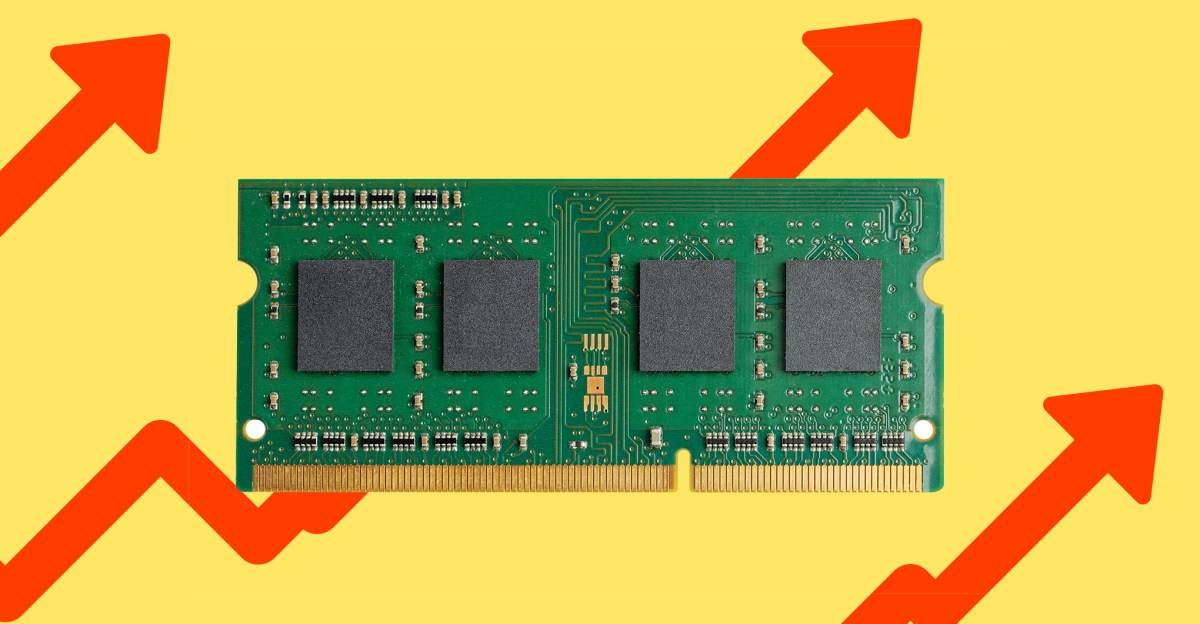
 Anton Shilov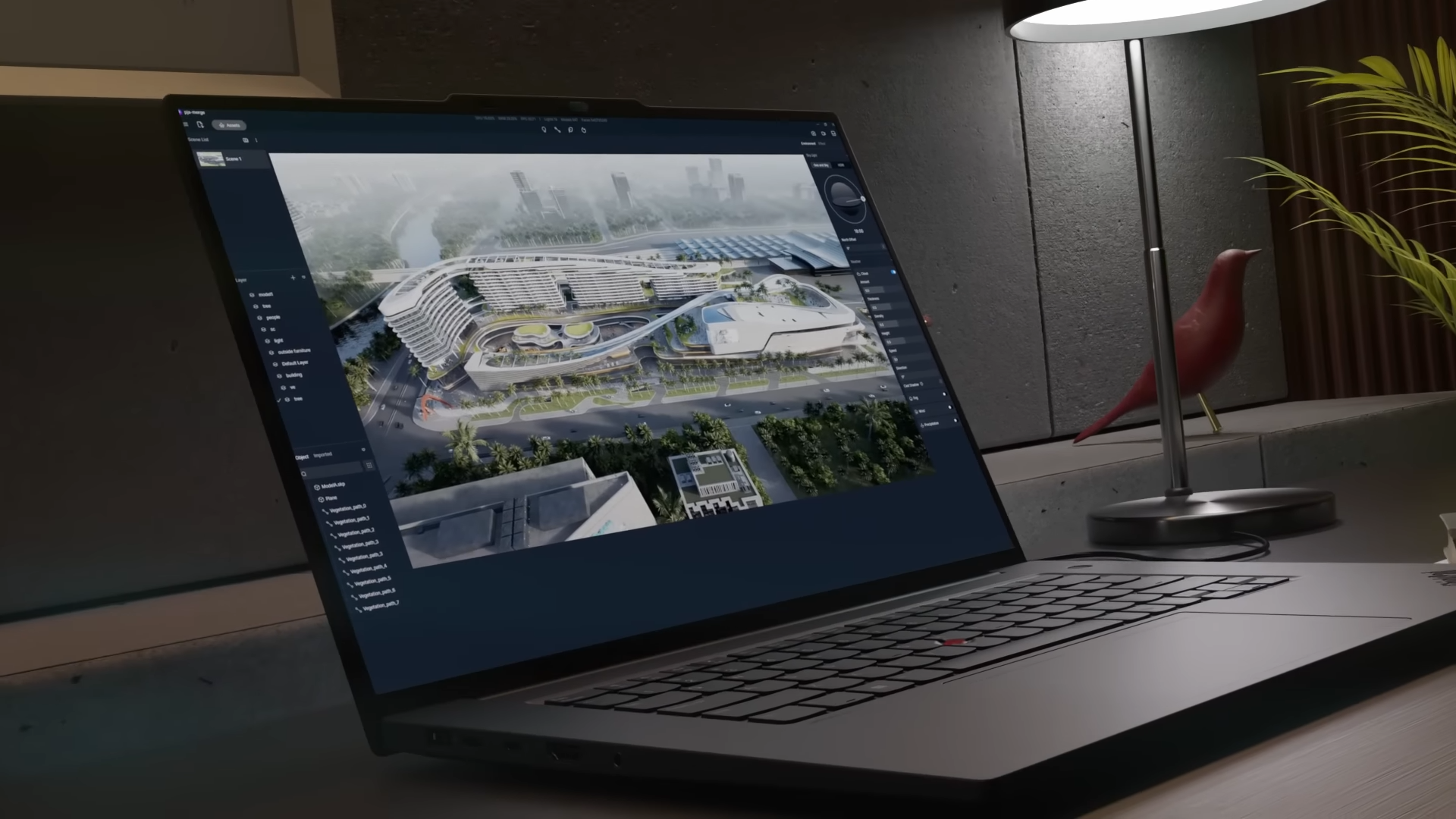
AI systems require substantial amounts of RAM because AI models need to store and quickly access big datasets and complex parameters during training and operation.
From Wikipedia:
Random-access memory (RAM; /ræm/) ... allows data items to be read or written in almost the same amount of time irrespective of the physical location of data inside the memory, in contrast with other direct-access data storage media (such as hard disks and magnetic tape), where the time required to read and write data items varies significantly depending on their physical locations on the recording medium, due to mechanical limitations such as media rotation speeds and arm movement.
If these price hikes continue, this is where every piece of technology in our lives is about to get weird and trippy, man. I'm not sure manufacturers can eat this. It is coming for us. Let's take a look:
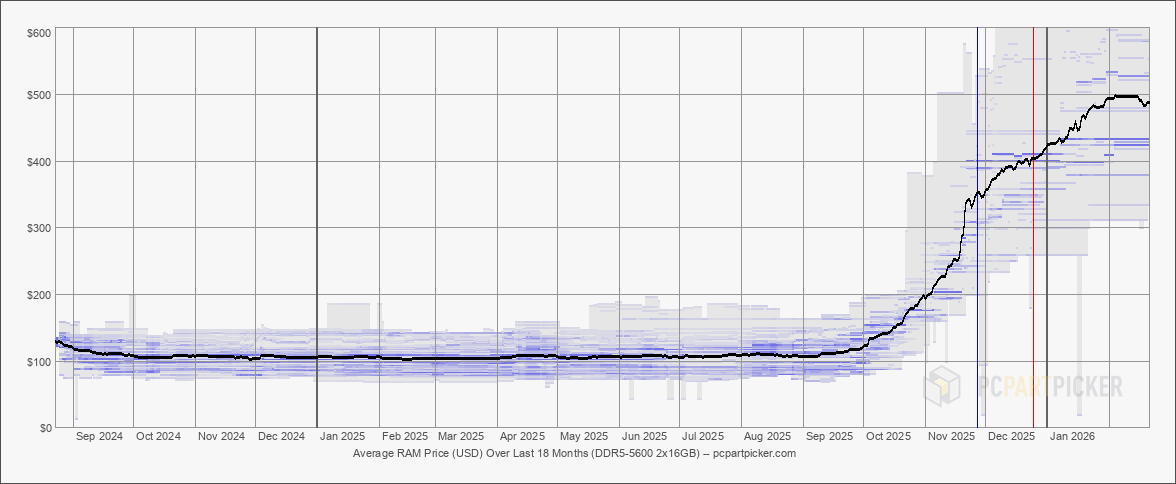
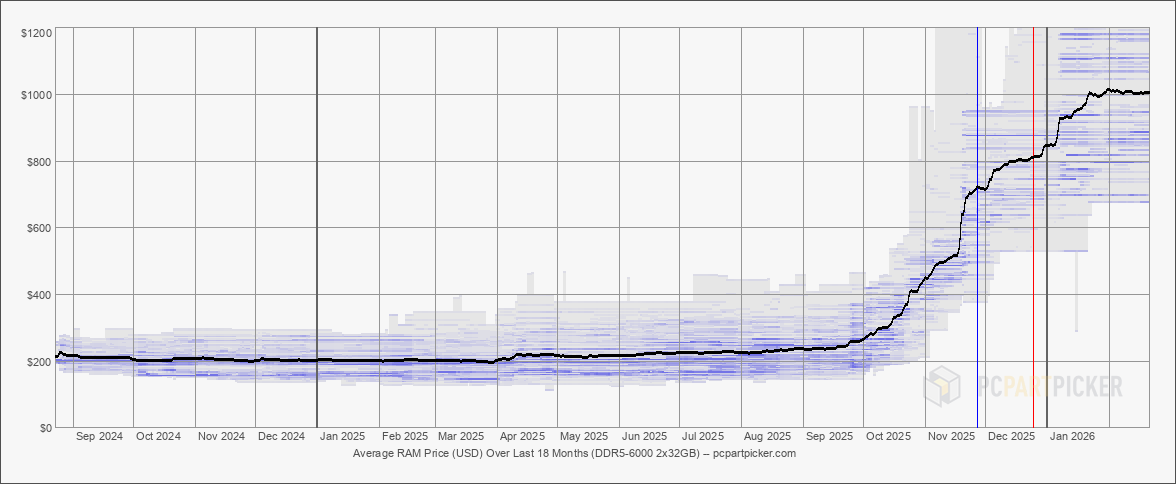
A 400% increase in price.
With a massive jump and some stabilization and plenty of volatility, here we go!
From The Verge:
It doesn’t look like the RAM shortage is going to subside anytime soon, as analysts at the International Data Corporation predict that it could “persist well into 2027.”
PC companies are already passing the buck onto their consumers:
Due to ongoing RAM shortages and the price of ram skyrocketing, we are now providing the option to select no ram in the build section of our website!
— Paradox Customs (@Brparadox) December 19, 2025
If you already have RAM sticks or can source them elsewhere, feel free to use this option ✅ pic.twitter.com/rlGLPpfznC
It's bad when the high-end gaming computers come without RAM.
I'll check back in here in a few months.
The Future
 Roman Loyola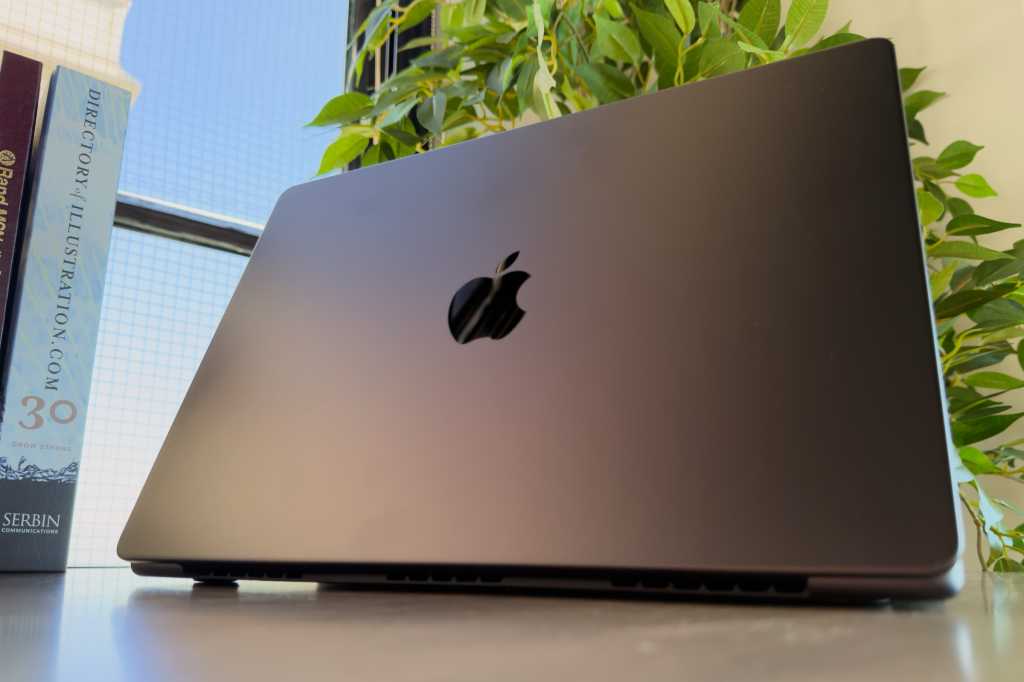
And there it is. How long will Apple eat these prices is something I have no idea. In December, Macworld also reported: Apple is uniquely positioned to weather the current RAM storm, but it can't hold out forever. That's two months between these two articles from the same publication - this is an issue to watch.
I'd say, if you were thinking of purchasing a new high-end computer from them now is the time because of how unstable things might become. To attempt to predict the future, I think buysellram.com does a good job:
Short-term (2026): Every forecast calls for continued steep price inflation through mid‑2026. Consensus is Q1’26 vs Q4’25: DDR (DDR4/DDR5) contract +55–60% and NAND Flash +33–38%. Client SSDs +40% in Q1. Early 2026 prices in many categories may be 2–3× year-ago levels.TrendForce indicates even larger hikes in Q2 are likely. (For perspective, one industry estimate had DRAM up ~50% in late 2025 and another +70% in 2026.) Device makers are preparing accordingly – IDC and Gartner note that PCs, smartphones and other devices will see higher BOM costs (IDC projects PC and phone ASPs rising several percent) and are advising OEMs to either raise prices or cut features.
Medium-term (2027–2028): Relief is not expected until major new fabs come online. Leading-edge “1βnm” DRAM plants (SK Hynix, Samsung, Micron) are under construction but won’t reach full volume until ~2028. Analysts warn tightness through at least 2027. For example, some suppliers are quoting 2026 pricing in year-long contracts and avoiding long-term deals because “rising DRAM prices through 2027 make long-term deals less attractive”. In short, structural supply constraints mean that unless unforeseen changes occur, memory prices will likely remain elevated through 2026–27, with normalization only as new capacity finally arrives.
I think for RAM prices, we're just going to have to ride it out. For storage, I use a site called Disk Prices to help shop for drives. For some of my personal storage needs, I've bought used and haven't had any problems. Check it out:

With RAM and storage going haywire and analysts predicting a potential respite in at least 2027 - how do you plan to navigate increased prices and shortages. Sound off in the comments, Instagram or LinkedIn.
Thanks for reading, until next week.

Help get CXM off the ground - take 50% off an annual subscription. I'm working hard to bring you actionable intelligence at the intersection of AI and visual storytelling. Expires June 1, 2026.